
Label It
Or the only AI take I'm willing to defend (and why I'll happily guillotine industrial slop)

Lately, Barnes & Noble CEO James Daunt said he has “no problem” selling AI-written books in his stores, as long as they’re clearly labeled as such and there’s consumer demand. People (like me), predictably, lost their mind.
I mean… I’m a writer. AI-generated stuff affects any creative artist in a way that could drive us to dig up the old fashioned guillotine. But. BUT. I’ve been thinking about this for a few days, and I keep arriving at the same uncomfortable conclusion: Daunt is not completely wrong.
Ok, let me explain before you put my name in the to-be-guillotined list.
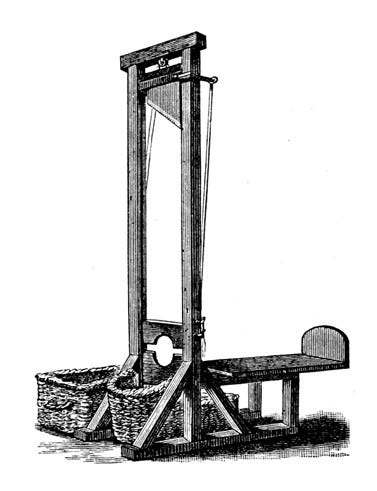
Firstly, since the internet doesn’t do nuance well and I’d rather not spend the next week in someone’s quote-tweets, let me be very clear that I freaking hate AI generated “art” too. Deepfakes, auto-generated videos mimicking films, prompt-to-publish book, every use of AI to replace human creativity, should be condemned and shut down as soon as possible. I’ll be happy to oil the guillotine rope myself.
But this is not a mere artistic issue. It’s a greed issue. Companies will always find the cheapest way to produce something if the market lets them get away with it. AI just made that cheaper than ever. And this is one of the many reason we all need to face the sad truth: AI-generated “art” it’s not going away. Pretending it will be the literary equivalent of hoping streaming goes away so we can all go back to Blockbuster on a Friday night. It had its charm. I loved it. But it’s not coming back.
So if it’s not going away, the question is: what’s the best realistic outcome we can actually push the market for before it’s too late?
On labeling books.
Daunt’s answer “label it” is, frankly, the most sensible thing I’ve heard from anyone in a position of power on this topic.
He said it himself: “I actually have no problem selling any book as long as it doesn’t masquerade or pretend to be something that it isn’t.” And then added something that should concern everyone: Barnes & Noble has 300,000 titles across its stores, and AI-generated books may already be on those shelves without anyone knowing.
That last part is the actual problem.
While part of the internet wants to eradicate AI-generated books, another part is already publishing and selling them (and some of those people are loudly quite proud of it). This means that, like it or not, there’s people buying AI-generated stories. We can expect (and hope) that most people have no idea what they’re buying. But this makes the whole story even worse: think of it like “Made in” on clothing. You buy a shirt, you can check where it was made, and decide whether that aligns with your values and morals. You do know in some places there are literally slaves making your shirt. It’s up to you to care or not. That label gives you the choice. Nobody’s forcing you to buy or not. You just get to make an informed decision.
That’s what labeling AI books (and any other kind of art) would do. It makes readers informed about what they are going to buy. Can we stop readers to buy AI-generated stuff? Nope, unfortunately putting very little guillotine on the registers to cut off hands of AI-buyer is pretty illegal anywhere* so the only thing we can do is make them informed they are buying slop and hope their morality - and taste - are a bit better than this.
(*ND: it’s a joke I’m not for cutting people’s hand… usually)
The crusade to make AI disappear from publishing is understandable, and I’m totally in. But that battle is going to be very long and the result is uncertain. And as a millennial, I know the feeling of lost battles: we rooted electric cars and bought organic apples from hipster greengrocers at triple the price to save the planet, and then Bezos sent his girlfriend to space on a rocket and Kylie Jenner took her private jet to go shopping. Seventeen minutes of flight. I can’t pollute as much in my entire existence even if I try very hard. But, yes, I’m still buying expensive apples and biological stuff.
And there’s a next step worth mentioning.
While I was writing this, the music industry gave us a concrete example of where labeling can go. Tidal announced that starting July 15, any track wholly or substantially created with AI has to be labeled and those songs won’t be eligible for royalties.
This is labeling with teeth. It doesn’t ban AI music (that frankly would be impossible) it just removes the financial incentive to flood the platform with low-effort slop. And the scale explains why it matters: Deezer reported that 44% of all new music delivered to its platform — roughly 75,000 tracks a day — was fully AI-generated.
Now imagine that logic applied to books. Label the AI-generated ones, and make them ineligible for whatever bonus, promotion, or royalty structure the platform offers. Suddenly the prompt-to-publish factory churning out a hundred titles a week has a much weaker business case. You don’t have to ban anything. You just stop paying for slop.
That’s the version of this fight that would actually works.
AI as a tool.
AI isn’t born to write book. It’s a tool with a range of use so wide that it already is essential in so many industries and is also doing a great job in some very important fields (think about faster medical check, or help in gathering and comparing research data, etc.)
Everyone uses tools. We writers use Wikipedia for research, grammar checking software, writing software (most of them do typo check automatically), and so on. And Google… are we pretending we don’t use Google? Well AI does the same job but faster, deeper and more personalized.
Technology always made and always will make new tools that replace the previous one: there were paper encyclopedias, then Encarta replaced them (slow high five due to back pain if you’re old enough to remember it), then Wikipedia and Google replaced it, then AI is replacing both, and one day something new will replace them as well. Yeah, I know things are a bit more complicated but let’s take it as it is and stick to the point.
Now, I use AI. I used it for my sci-fi book because I’ve no time to get a degree in astrophysics and I needed to quick research how a different atmospheric composition could affect my FMC (and write a coherent composition that wouldn’t realistically kill her in sec). I use AI for this very post: I didn’t remember which celebrity flew here and there while I was buying locally grown carrots at double price, so I asked “hey who was that celebrity who did micro-flights?” and Google AI provided the answer in way less time I’d spent to search People’s archive and find out.
And, again, we’re speaking about using AI at a super basic level.
Back to what we should ask right now.
Short answer: Labeling. In my opinion as an affected person, the smartest fight, the one with a realistic chance of actually protecting human writers, is transparency. Labels. Standards. Giving readers the tools to make informed choices.
Again, it doesn’t solve the AI used as a replacement for human creativity. The prompt-to-publish model won’t disappear and greed companies would still rather pay a subscription fee than a human writer… well, until the subscriptions would be more expensive than getting back to humans or find a cheaper way. But it’d be a start. It may create market pressure: if readers consistently choose human-written books over AI-generated ones, the market would adjust (hopefully). If they don’t, well. That’s also information worth having while sharpening the guillotine blade.
It won’t be perfect. It’ll be gamed, contested, argued over. But it’s better than the alternative, which is AI books sitting quietly on shelves next to human-written ones, and nobody knowing the difference.
That’s already happening, by the way. Daunt said so himself.
So, yes, label it. It’s not a victory. But it might be the best outcome we’ll get in reasonable short term.
And in the meantime, I’ll keep buying the expensive apples. Someone has to.
— Your friendly neighborhood Procrastinator
Coming next: something less politically charged. Probably. I’m gonna procrastinate a bit now. Probably my first four-part short story
This is such a thoughtful, realistic take on the ongoing debate. Until the AI bubble bursts and it becomes too expensive to pump out slop, or we create a foolproof AI detection system, we’re stuck with it. I lump AI works in with fan fiction since they both incorporate other authors' creations without permission, but fanfic writers at least create their own stories with the borrowed material. I can't think of a single valid reason for letting a clanker put words on the page.
Completely agree. Just yesterday I read that Netflix used AI in over 300 titles. Maybe the bubble will burst but we need to make clear what is human made and what is not right now